Deepa — Boruto
Identity and affiliation
Deepa is an Inner of the Kara organization in the Boruto anime continuity, introduced as a top tier enforcer who operates alongside Victor during the Kara Actuation Arc. He is an anime-original antagonist rather than a direct adaptation from the manga. His first appearance is in episode 157, during Kara’s internal briefing after a facility is destroyed, and his storyline concludes in episode 175 when he is defeated by the newly improved Team Seven and then killed by falling debris inside Victor’s research complex. As an Inner, he has significant trust from Kara’s leadership and direct access to sensitive operations. He acts with broad autonomy, often ignoring requests for subtlety in favor of overwhelming force, and he serves as one of the earliest showcases of how Kara’s scientific augmentations rewrite combat dynamics in the post-war ninja world.
Appearance and visual design
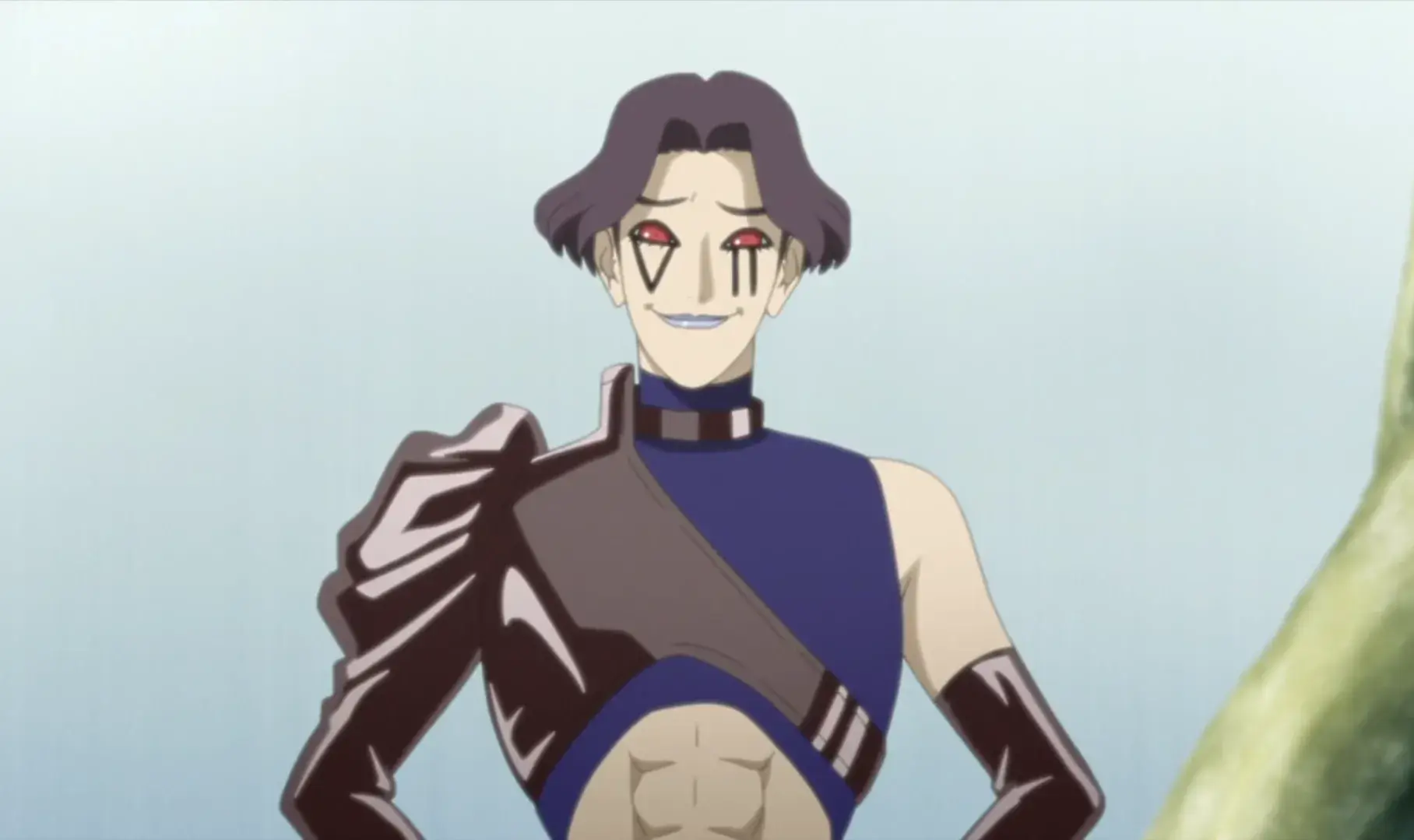
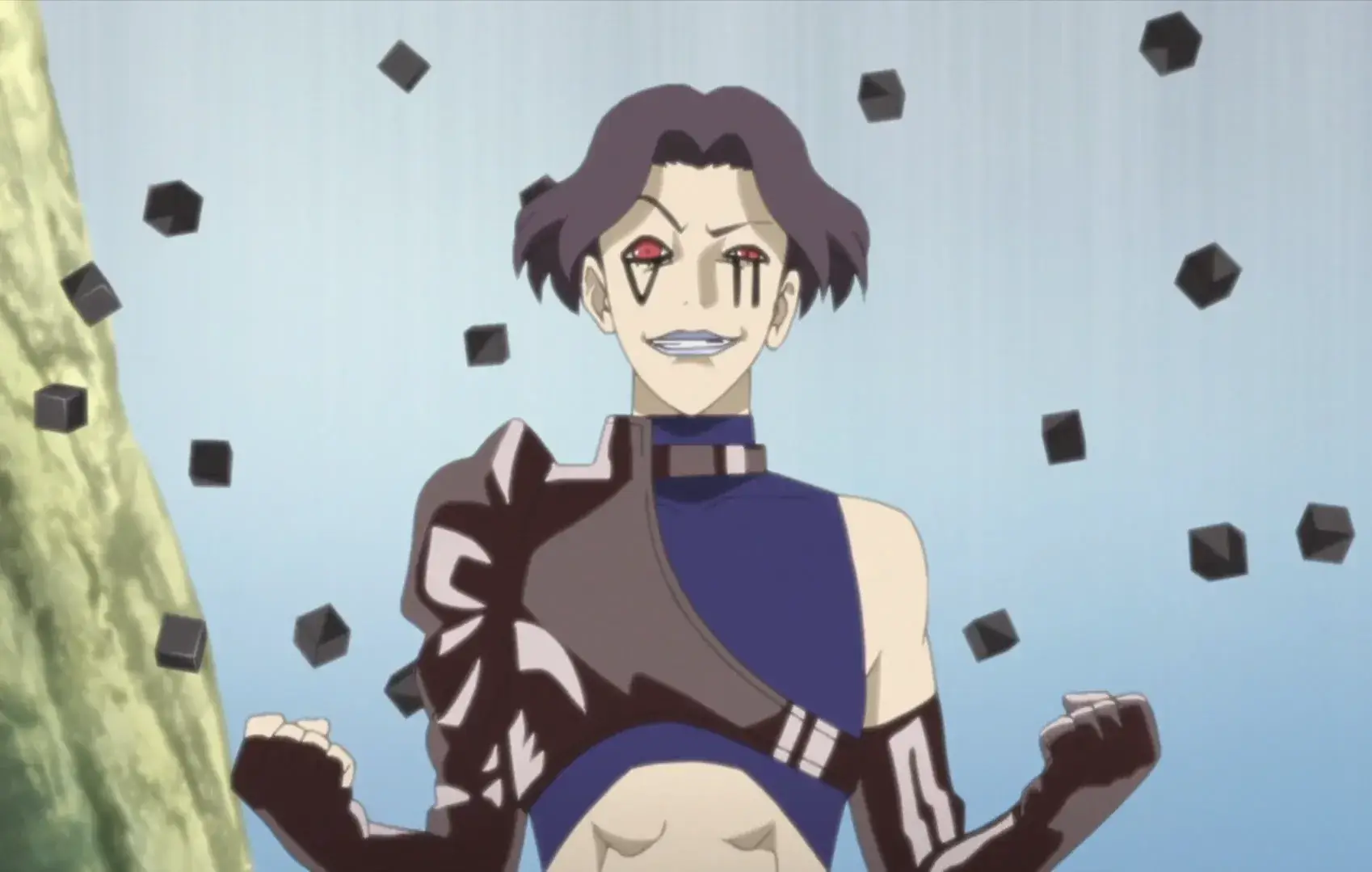
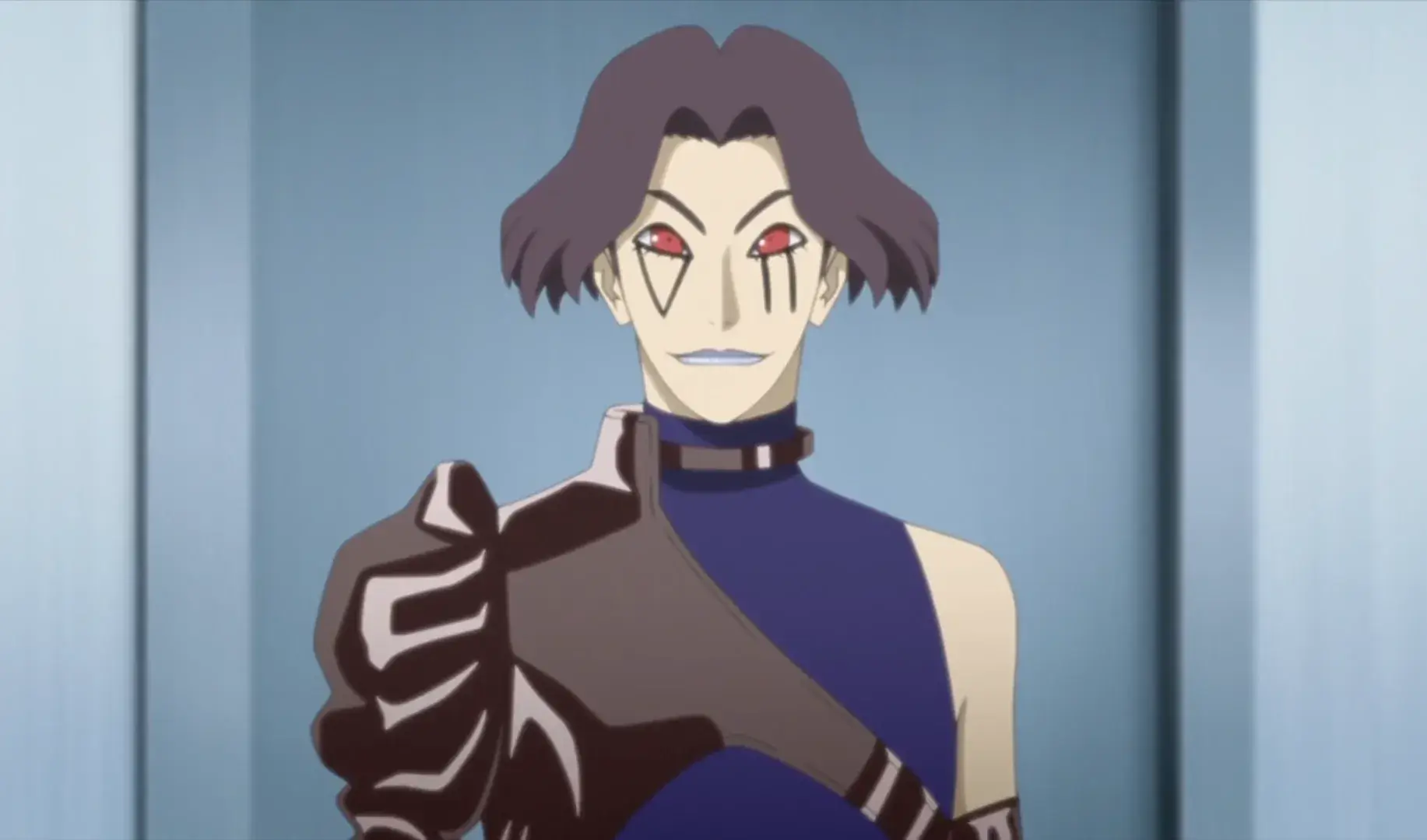
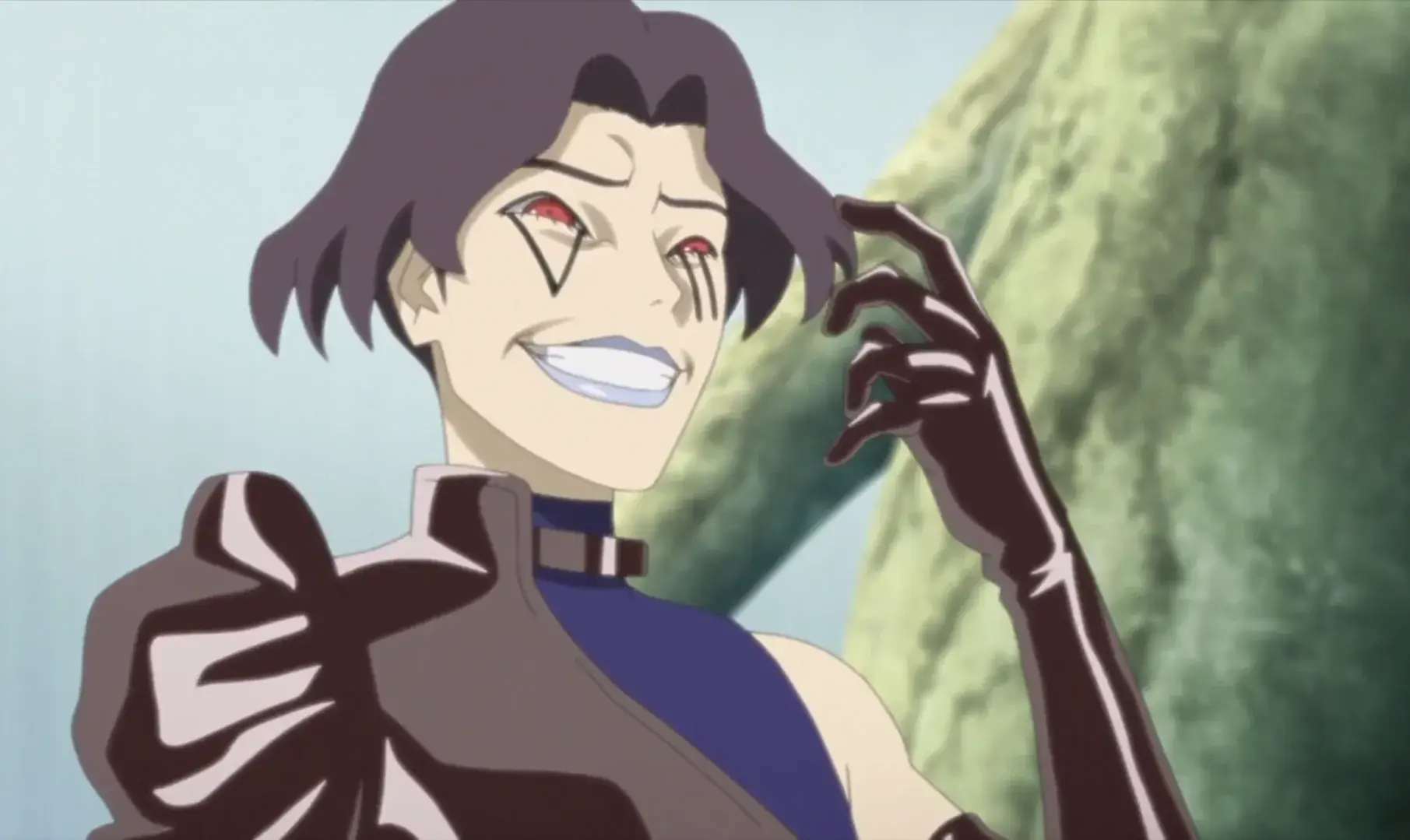
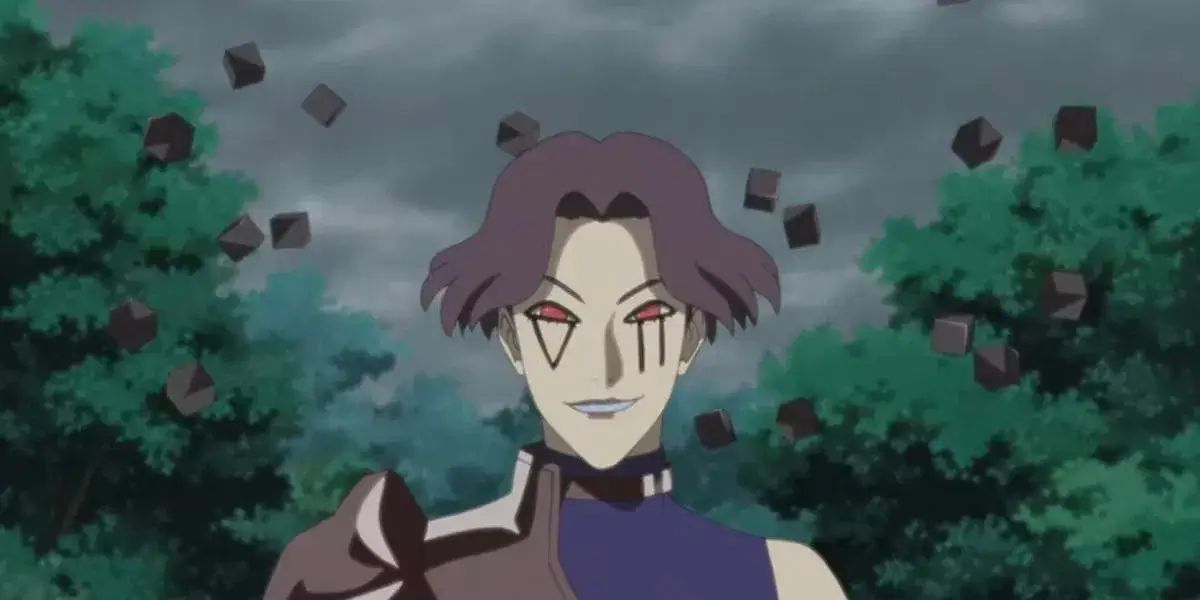
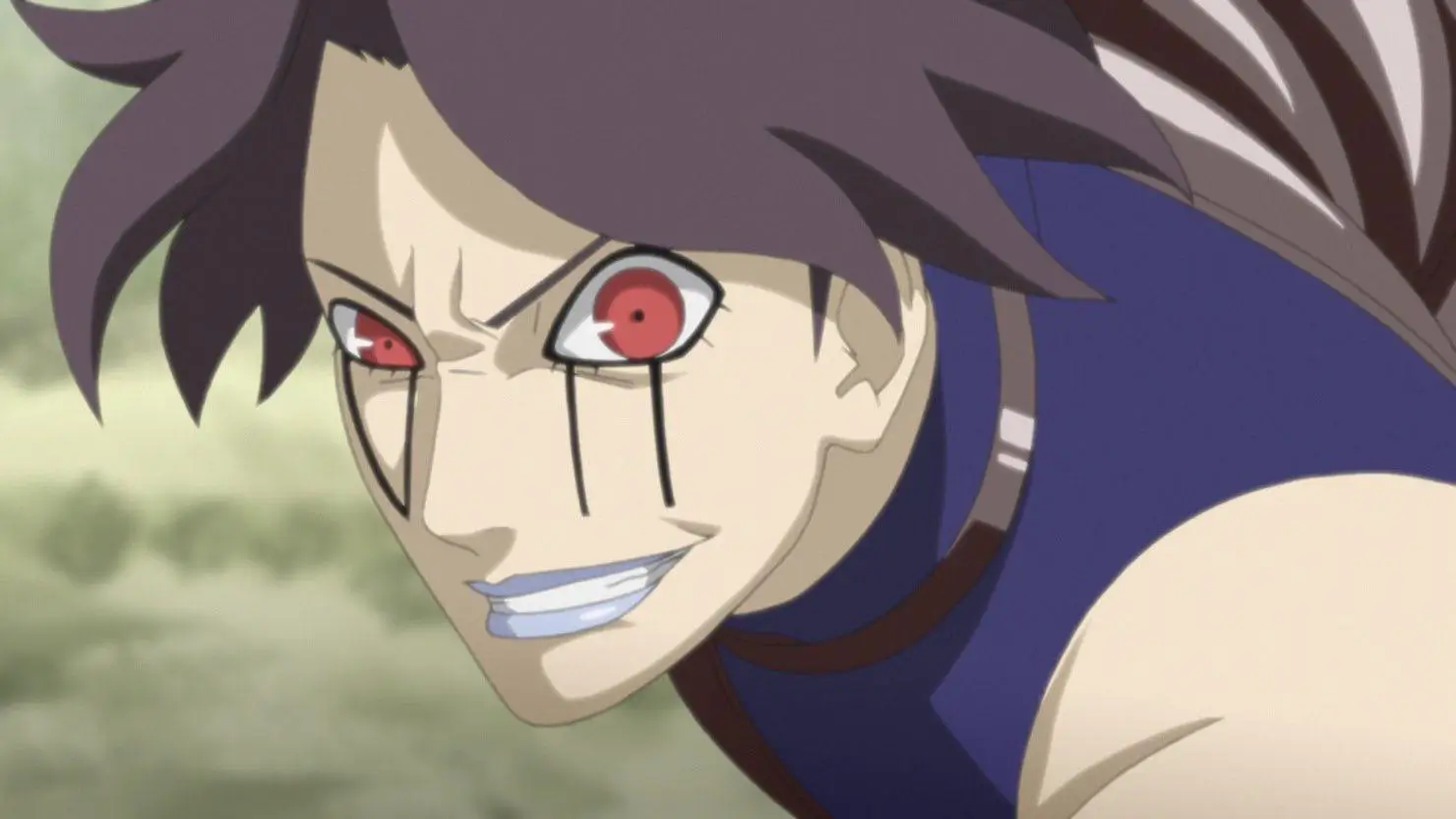
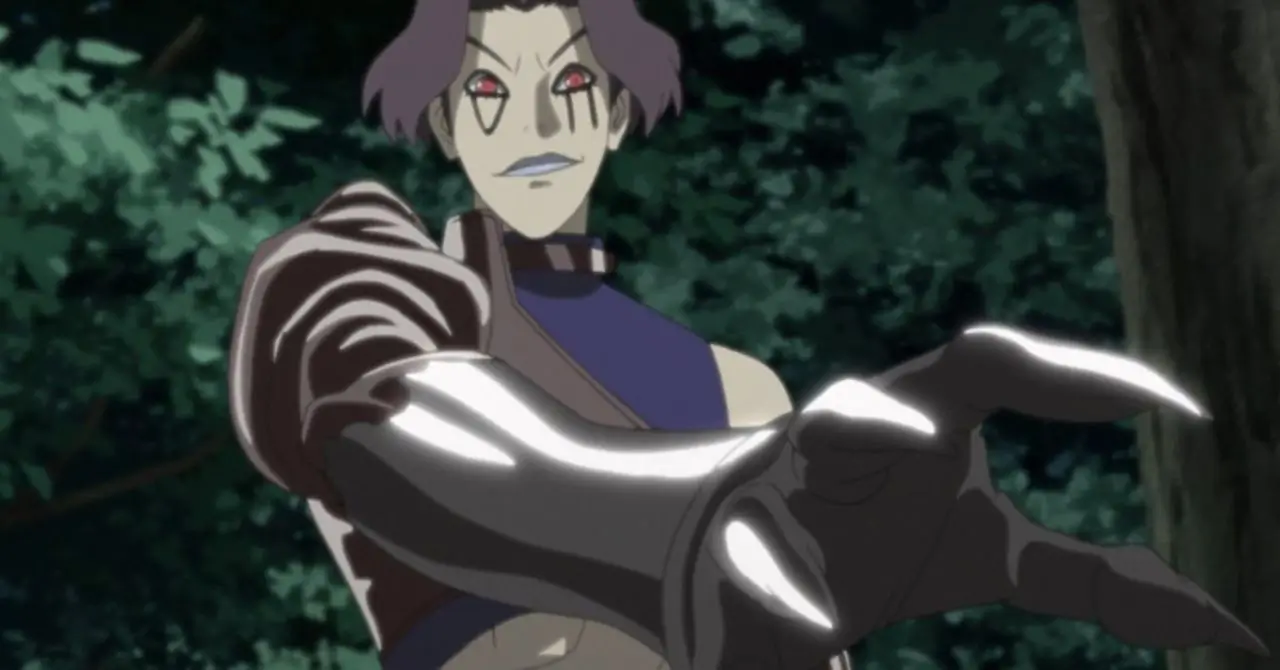
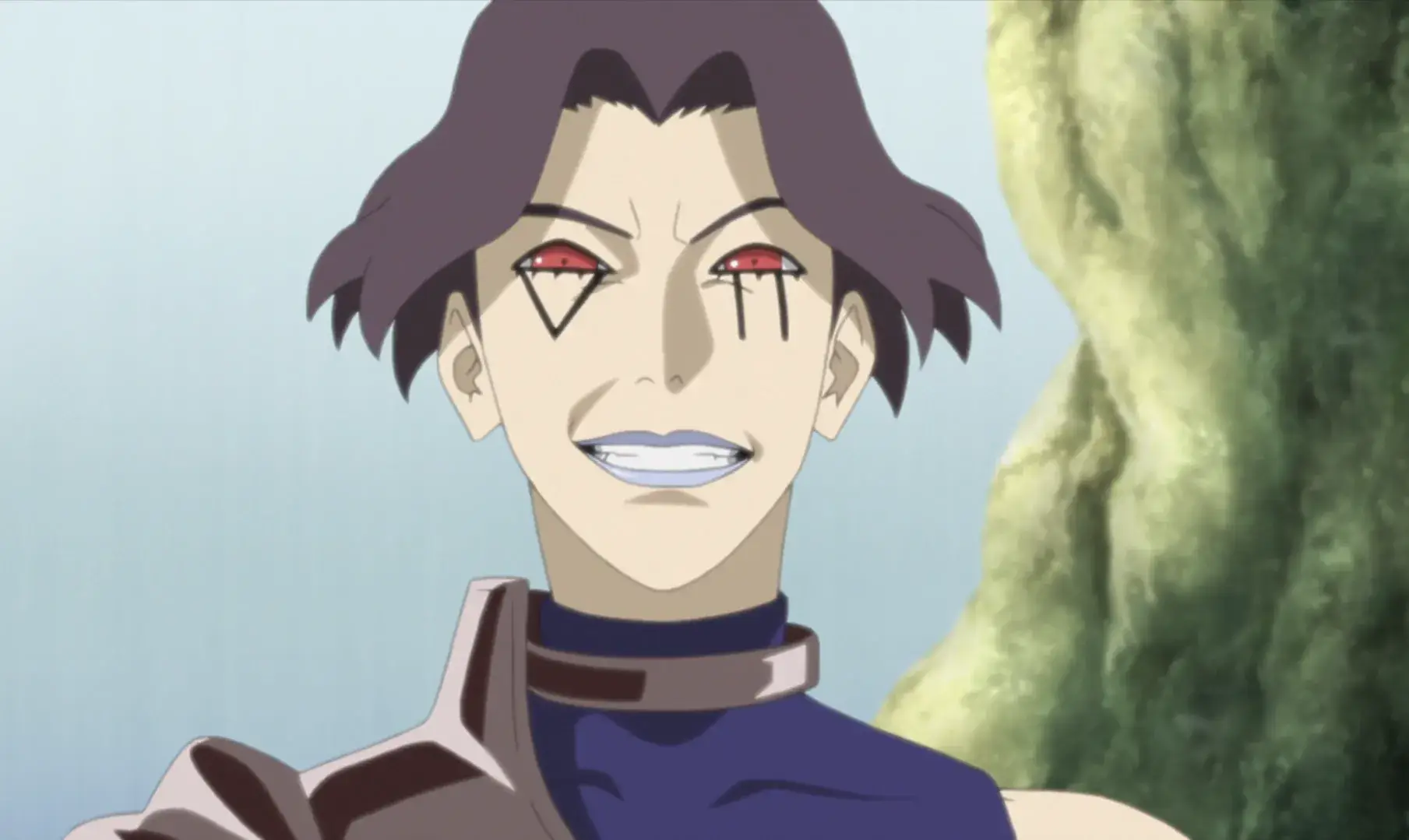
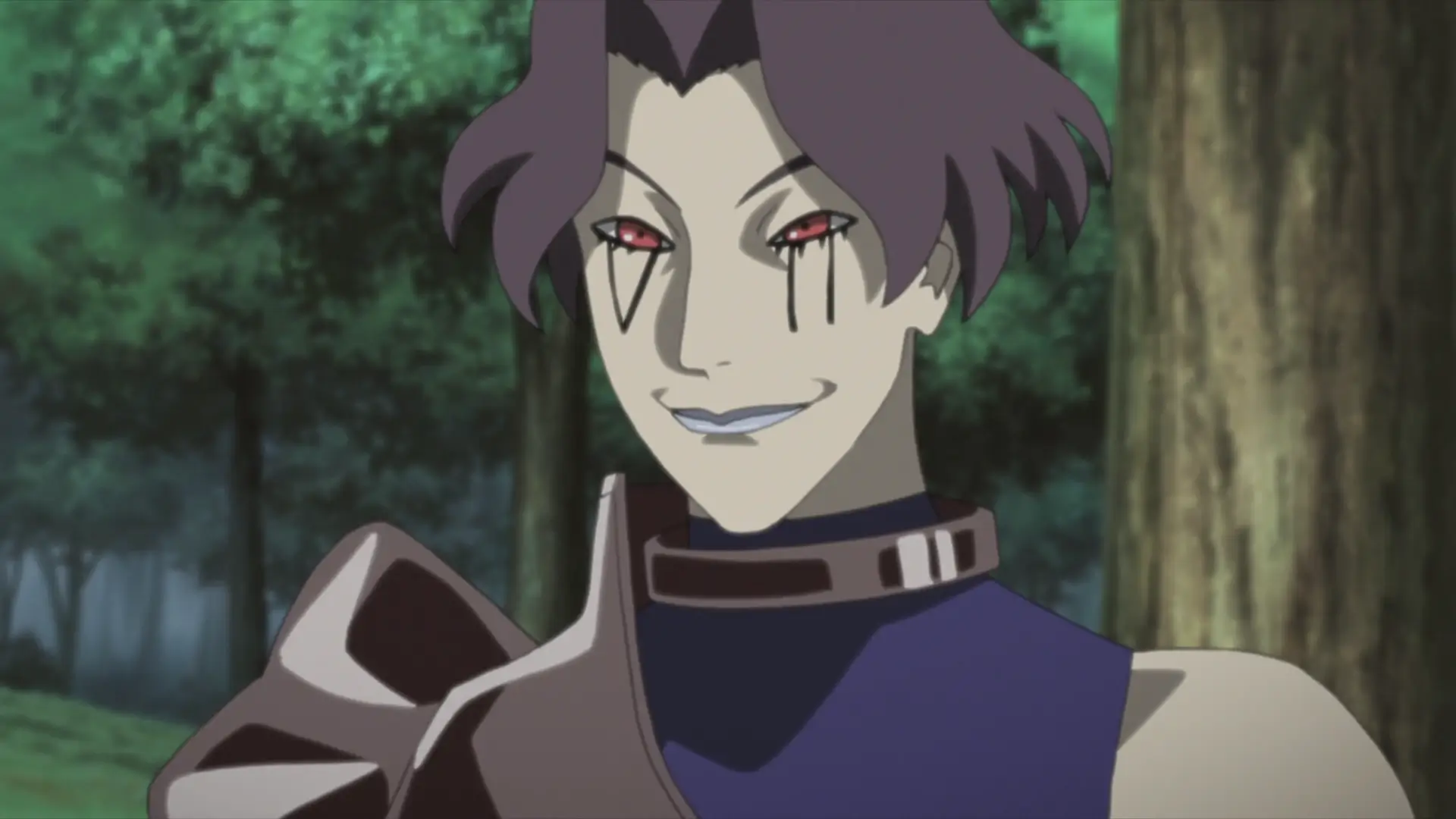
Deepa is tall, wiry, and hard-edged in silhouette, with short grayish-violet hair and orange-red eyes that give him a predatory gaze. Beneath both eyes he wears a tattoo resembling a stylized numeral mark, which visually anchors his face and heightens the impression that he is branded by the organization’s inner circle. He uses light blue lipstick that contrasts sharply with his otherwise dark color palette. His clothing fuses elegance with menace: a dark cloak with a maroon lining drapes over a blue collared cropped shirt, a symmetrical apron-like panel wraps his waist, and his arms are mismatched with a long glove on one side and a gauntleted, fingerless glove on the other. The asymmetry and layered textures echo his combat philosophy, which turns beauty, hardness, and refinement into a single aesthetic. When he activates his technique, his skin takes on a dark, mirror-like sheen that reinforces the theme of polished, engineered cruelty.
Personality and motivations
Deepa treats combat as a hunt and an art of despair. He delights in the second when opponents recognize their attacks have no effect, and he punctuates fights with sardonic comments delivered like a gourmand savoring a rare dish. He values sensation more than ideology, a trait that separates him from zealots or conquerors. He will kill without hesitation, yet he sometimes adheres to the narrowest reading of a promise, as when he spares Omoi after extracting information but immediately murders the teammates not covered by the bargain. This blend of theatrical sadism and technical literalism defines his interactions with both enemies and allies. He is vain about his altered body, calling it beautiful and treating its polished, carbon-refined hardness as an ideal. He is obsessed with taste, returning again and again to culinary metaphors, and he fixates on the idea of savoring a Chakra Fruit from a God Tree not as a means to rule, but as a once-in-a-lifetime flavor to experience. That fixation becomes his undoing when Victor’s artificial tree fails, distracting him at the precise moment Team Seven punctures his defenses.
Scientific augmentation and chakra framework
Deepa’s body is the result of extensive scientific ninja tool augmentation carried out within Kara’s research network. The anime positions him as a demonstration of how engineered biology can rival, and in some cases outclass, traditional chakra training. Instead of relying on a bloodline limit or inherited ocular power, Deepa’s performance comes from material manipulation integrated into his physiology. He shows competence with standard chakra control, but most of his battlefield impact arises from how he reconfigures carbon on the fly, toggling between extreme hardness, high cohesion, and elastic resilience. He can also participate in Kara’s remote communications using a projective technique associated with Yin Release, appearing as a spectral image to coordinate across distance. The key is that his “jutsu” behaves like a physics problem: bond structure, surface hardness, density, and stress distribution all matter more than raw chakra volume, and that requirement drives the way opponents must counter him.
Signature ability and material science angle
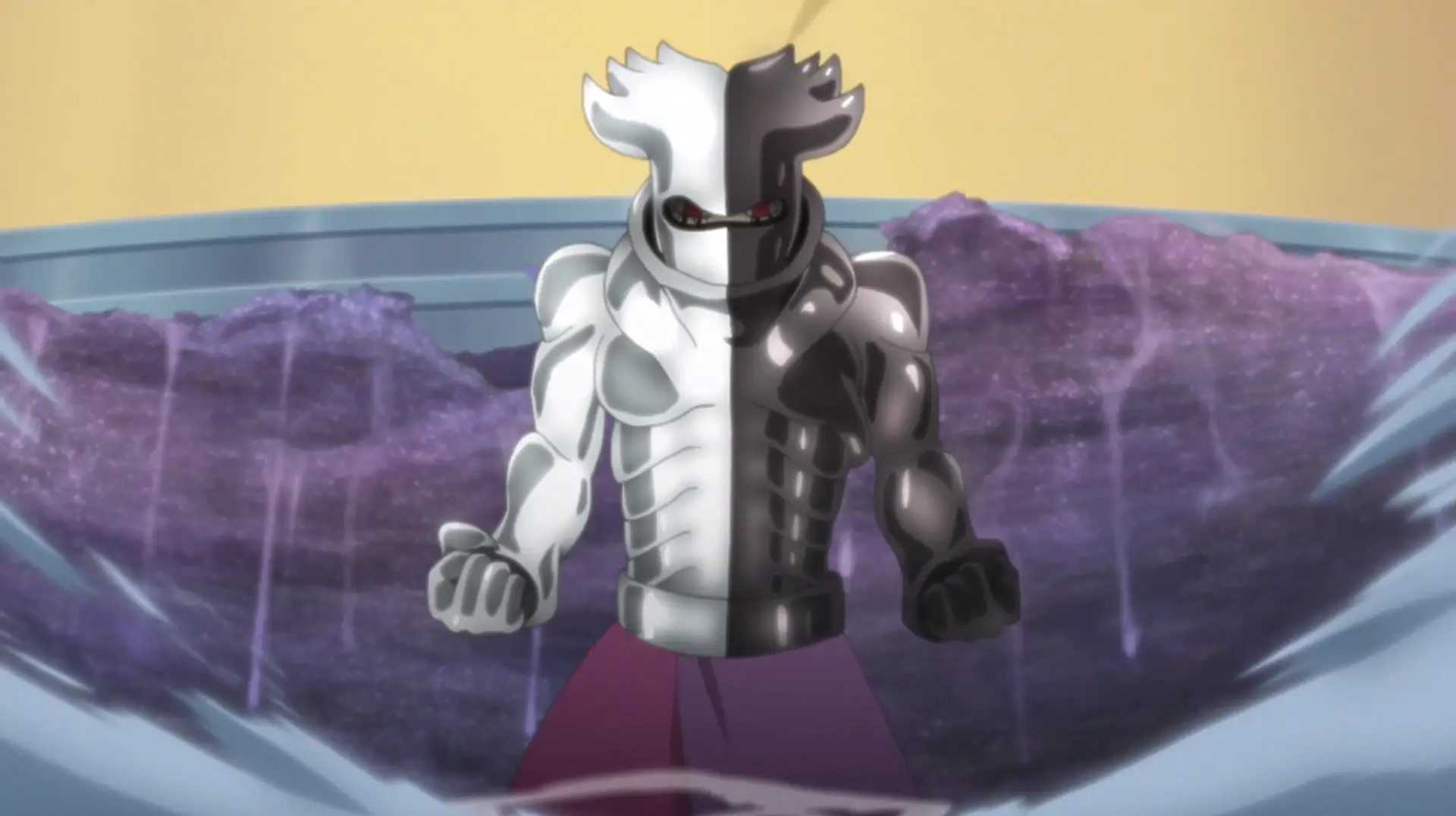
Deepa’s signature technique manipulates carbon both within his own body and in external sources. Internally, he transforms his skin and subdermal layers into a dark, reflective sheath that resists blades, elemental blasts, and concussive force. Externally, he compacts carbon into projectiles, whips, and geometric constructs that maintain extraordinary cohesion under acceleration. The visual language communicates a shift from mystical energy to engineered matter: when he hardens his body, light glints off surfaces like polished metal; when he fires, the shots carry weight that cracks defenses through density rather than chakra superiority. The anime frames this as an application of bond reconfiguration. Under ordinary attacks, the armor’s structure disperses energy across a wide surface and refuses to crack. Under a precise, high-velocity pierce focused into a tiny area, microfractures propagate, and a well-timed explosive follow-through can shatter the layer outright.
Carbon armor
The armor is the foundation of Deepa’s fighting style. In its base state, it coats his body closely, turning knives, kunai, and shuriken into meaningless scratches. Elemental attacks such as Lightning Release fail to penetrate, which is notable because lightning-enhanced strikes often pierce conventional defenses. Under pressure, Deepa escalates to thicker configurations whose polished, glassy luster signals an increase in hardness and mass. In this state, casual strikes from him can launch an opponent across a room, and a single precise thrust can punch through torsos or break reinforced barricades. At the apex, the armor becomes a bulky exoskeletal shell with near-impenetrable hardness described in-universe with the language of refinement, as if he has driven the material toward a diamond-like phase. This ultimate shell, however, is slow to adapt compared to the thinner layers; it buys time and can smother escalating threats, but if an enemy seeds a crack and then immediately hammers the same locus with a compacted explosive technique, the shell catastrophically fails.
Projectiles and constructs
Deepa shapes external carbon into bullets, darts, and cubes that he launches in sustained barrages. He can flood the field with medium-density shots that force defenders to turtle behind walls, or he can condense mass into fewer projectiles that strike with terrifying penetration. In the Land of Wind, he compacts a round that smashes through Shinki’s Iron Sand wall, a defense that had previously stymied strong adversaries. He can also form whiplike tethers that lash across wide arcs, and rings that snap shut around targets to pin limbs or crush breath. When threatened by close-quarters uprisings, he binds, reels foes into his reach, and breaks their formation with armored punches. The constructs, like the armor, are tuned to the problem in front of him: when he needs area denial, he sprays; when he needs a breach, he compacts; when he needs control, he lashes or cages.
Mobility and durability
Despite the weight implied by his materials, Deepa moves quickly and with precision. He reads multi-angle assaults, catches blades with armored fingers, and slips through openings he creates with suppressive fire. His durability under sustained damage is extreme. A suicidal kinjutsu detonation in the Land of Valleys barely scorches his surface. He walks out of smoke and collapsed masonry unbothered, more irritated by the dust than by the force itself. His taijutsu forms are economical, stripped of ornament, and aimed at breaking rhythm rather than exchanging blows. Where many heavy defenders trade mobility for resilience, Deepa remains agile until he chooses the ultimate shell, and even then he wields enough control to absorb and redirect incoming energy.
Combat chronology
Deepa’s story unfolds across several linked operations. He enters as Kara scrambles to recover stolen Hashirama Cells connected to Victor’s company. The trail leads to the Land of Valleys, where he asserts control with casual slaughter, then into confrontations that test the protagonists’ current ceiling and force them into rapid evolution. He later appears in the Land of Wind on a related objective before returning to Victor’s facility for the final battle. Each step reveals a facet of his philosophy and a new requirement for counters, culminating in a defeat that rests less on power inflation and more on technique design and timing.
Hashirama Cells and the encounter with Omoi
After a Kara site is compromised, Deepa is assigned to retrieve samples of the legendary Hashirama Cells. He refuses covert methods, strolling into spaces where everyone has already been killed, paying for his meal as if the corpses were décor, and moving on with a smile. Tracking the cells through Curtain Village and Fūshu Castle, he eliminates criminals and intermediaries who get in the way. When Team Seven joins forces with a trio of Kumogakure jōnin led by Omoi, Deepa crushes them with frightening ease. He offers Omoi a narrow promise: provide information and live. Omoi complies to protect his subordinates. Deepa then kills those subordinates immediately, arguing that the promise covered only Omoi. The moment crystallizes his character. He is not a chaotic butcher; he is a sadist who extracts despair from the letter of a bargain. He departs with the samples and without a scratch, leaving behind fear and a brutal lesson about misplaced trust.
First clash with Team Seven
The confrontation that follows becomes a keystone for the series’ power development. In episode 166, titled Death Match, Deepa faces Boruto, Sarada, and Mitsuki after Victor arrives to occupy Konohamaru and Mugino. Every combination the genin attempt bounces off the armor. Boruto’s Rasengan, then the team’s chain attacks, then more desperate efforts, all register as nothing. Deepa often pretends to be slightly affected, only to reveal seconds later that the damage was an act. When an ally triggers a suicidal sealing technique within the battlefield, Deepa walks away unmarked. Facing imminent execution, Mitsuki breaks his own rules and triggers Sage Mode as an emergency measure, flooding the field with senjutsu lightning and buying just enough space to evacuate Boruto and Sarada. The price is severe damage to Mitsuki’s body that forces him into medical stasis. The entire sequence leaves Team Seven humiliated and reorients their training priorities around precision, density, and timing rather than bigger, flashier blasts.
Land of Wind incident and clash with Shinki
Deepa’s next major appearance takes him to the Land of Wind in search of an Ōtsutsuki-related puppet. He massacres bystanders with the same blasé detachment seen earlier, then engages a coalition that includes Team Ten and Team Shinki. Shinki’s Iron Sand constructs, usually a fortress, crumple in front of a single condensed round from Deepa. The shot demonstrates how the carbon system scales output: compact mass, shorten contact area, accelerate delivery, and even magnetic sand barriers buckle. After the victory, Deepa notices heat stress on his own hand, a tiny acknowledgment that repeated high-density firing strains his system. Shinki destroys the target puppet in defiance, denying Deepa the prize. Uninterested in a prolonged cleanup and confident in his larger mission, Deepa withdraws. The encounter sends another message to the protagonists: conventional defenses do not survive encounters with engineered matter driven past normal hardness thresholds.
Preparation and growth of the protagonists
Humiliated and motivated, Boruto seeks instruction on how to compress and stabilize his Rasengan. The training yields the Compression Rasengan, a technique that packs more energy into a smaller volume, sharpening both rotational speed and impact. Sarada polishes her Chidori under real combat timing rather than treating it as a heritage showpiece, and the pressure pushes her Sharingan toward further maturation. These upgrades do not inflate raw chakra reserves. Instead, they address the materials problem Deepa poses: create a precise pierce to seed a crack, and follow immediately with a compacted, explosive force that exploits the fracture before his armor can reconfigure.
Final battle at Victor’s facility
Episode 175, titled Beyond the Limits, stages the rematch. Victor’s research complex houses an experimental God Tree intended to siphon chakra and cultivate a Chakra Fruit. While Konohamaru and Orochimaru deal with Victor’s scheming, Boruto and Sarada confront Deepa again in a vast chamber lined with geometric platforms that suit his projectile patterns. He opens with suppression, layering armor and launching scything whips and dense volleys that deny easy approaches. Boruto’s improved Rasengan dents the intermediate layer but does not break it. Sarada throws herself into the path of a collapsing cubic construct to save Boruto and, under the triggering stress, her Sharingan awakens a second tomoe. The expanded perception window lets her thread a Chidori into a minute opening at the moment Deepa shifts facets. The strike seeds a crack. Deepa escalates in response, encasing himself in the ultimate shell even as the experimental God Tree withers and collapses. Mitsuki, recovered enough to move, arrives and funnels chakra into Boruto’s already compressed Rasengan, elevating it into a Super Compression variant. Boruto drives the focused sphere into the same locus Sarada pierced, and the shell ruptures along the pre-existing fracture lines. Deepa is hurled backward, stunned but still breathing, when a massive slab of wreckage, loosened by the dying tree’s convulsions, crushes him. His last regret is not tasting the fruit. The narrative is clear: he is defeated by timing, density, and collaboration rather than by an arbitrary surge of spiritual power.
Aftermath within Kara
In the arc’s denouement, Victor attempts to frame the disaster on Deepa, salvaging pieces of the body to dress the scene. Jigen is unconvinced. He orders Amado to recover Deepa’s brain for interrogation, extracts whatever data is useful, and then has the remains dissolved. The sequence shows Kara’s internal logic. Even an Inner, valued for results and trusted with major operations, is disposable the moment his usefulness ends. It also underlines the cold contrast between Deepa’s theatrical cruelty and the organization’s bureaucratic brutality. Deepa wanted to savor a flavor. Kara wanted information and deniability. Once those ends are achieved, the man who believed his refined body was the most beautiful thing in the world is reduced to slag in a tank.
Tactics and counters
Counters to Deepa’s system revolve around precision, density, and synchronization. Broad elemental blasts distribute stress across too large an area, allowing the armor’s lattice to absorb the blow. Repetitive attacks at the same power level teach the armor’s adaptive layer what to expect, making the next exchange even less effective. The correct approach is to make a small hole and then make it catastrophic. Chidori serves as the surgical tool: a high-velocity pierce that focuses charge and momentum into a pinpoint. The Compression Rasengan serves as the hammer: a compact, high-density thrust that floods the same microscopic site before the structure can heal. The timing matters more than the scale of the techniques. In their first fight, Team Seven had neither the pierce nor the density. In the rematch, they had both, layered in the right order with support from Mitsuki at the key moment.
How the armor fails
The armor’s strength is its bond configuration under distributed loads. Knife edges, standard Rasengan, and many elemental bursts smear force across a wide surface. When a pierce focuses force into a tiny patch, local bonds reach their limit and begin to separate. If nothing follows immediately, the system can redirect stress, thicken, or reconfigure to close the crack. If a second strike with very high energy density arrives in the next instant at the same locus, crack propagation outpaces the material’s ability to adapt, and the layer shatters along radial lines. The ultimate shell complicates this picture by adding thickness and hardness, but it also slows adaptive behavior. That tradeoff buys survival against diffuse explosions and heavy impacts, yet it makes a precise pierce plus immediate follow-up even more dangerous when executed perfectly.
Impact on Team Seven’s growth
Deepa forces a shift from spectacle to engineering. Boruto’s evolution toward compression changes the way his signature technique works at a fundamental level. Sarada’s Chidori becomes a repeatable battlefield tool rather than a situational gambit. Mitsuki’s arc underscores the cost of emergency power and the need for team designs that do not rely on body-breaking gambles. By defining a problem that brute chakra could not solve, Deepa sets the conditions for smarter, tighter jutsu that serve the series well in later conflicts. His influence persists even after his death because the protagonists now think about stress, fracture, and timing when they design counters to other augmented enemies.
Relationships
With Victor
Victor is Deepa’s frequent counterpart, a corporate magnate whose medical conglomerate doubles as a front for Kara’s experiments. The two cooperate because their goals overlap, not because they respect each other. Victor prefers plausible deniability and covert logistics. Deepa walks through the front door, kills witnesses, and leaves. He mocks Victor’s desire to dress atrocity in boardroom polish, and Victor regards Deepa as a useful but embarrassing implement. Their final mission lays bare the split. Victor wants the God Tree’s power and prestige; Deepa wants the taste of the fruit. Neither gets what he wants, and both die as a result, one crushed by rubble, the other cut down after overreaching.
With Team Seven
With Team Seven, Deepa is the wall the young heroes must climb. He exposes the limits of their then-current arsenal and almost kills them for trying. He takes palpable joy in Boruto’s initial despair, in Sarada’s frustration, and in the moral injury of Mitsuki’s emergency transformation. The rematch flips the script without cheapening the first defeat. Boruto and Sarada return with refined tools tailored to the problem Deepa represents, and their victory confirms that smart design beats brute repetition. Their relationship with him is not personal in the way rivalries sometimes are; it is formative. Deepa becomes the standard against which their training is measured.
With Omoi and Kumogakure
Deepa’s interaction with Omoi shows a paradoxical honor bound to cruelty. He keeps his exact word to spare Omoi, but he exploits the loophole to murder the teammates Omoi sought to protect. The lesson lands with surgical precision. In a world where vows and codes matter, Deepa demonstrates how a sadist can inhabit the letter while violating the spirit. The scene also broadens the scope of his menace beyond Konoha’s rookies by showing him dismantling competent adult jōnin with ease.
With Kara leadership and Amado
Deepa defers to Jigen in the way a dangerous subordinate defers to a boss he recognizes as untouchable, but there is little reverence in it. He treats assignments as hunting licenses. Amado, Kara’s chief scientist, represents the cold intelligence behind Deepa’s body. Amado’s brief interaction with Deepa’s remains in the aftermath is telling. He treats the once-fearsome Inner as an object for data extraction. Once the contents of the brain are copied and examined, the remains are dissolved. For all Deepa’s vanity and theater, his place in Kara is utilitarian.
 All rights reserved © 2025